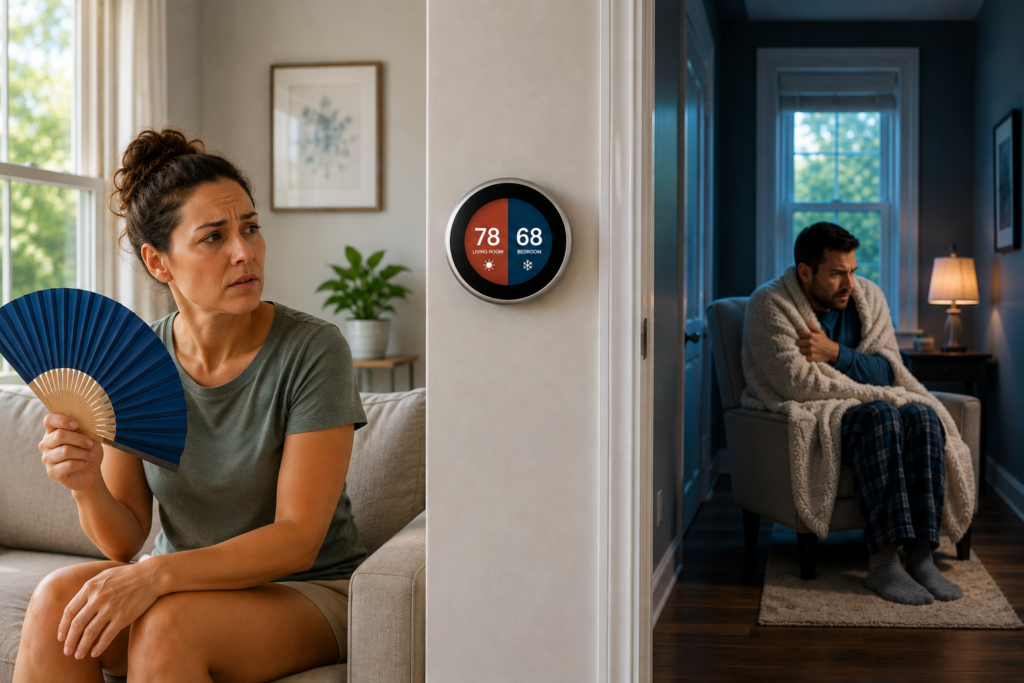

If your home never quite feels comfortable, too cold in winter, too warm in summer, or uneven from room to room, your HVAC system may not be the right size. That’s a common issue for homeowners across the Northeast, especially in older homes or houses that have been renovated over time.
Before replacing a furnace, boiler, or air conditioner, it helps to understand one critical number: BTUs. Calculating the right BTU heating and cooling capacity is the foundation of proper system sizing, better comfort, and lower energy costs.
What Is a BTU?
BTU stands for British Thermal Unit. In simple terms, it’s a measure of heat energy.
One BTU is the amount of energy needed to raise the temperature of one pound of water by one degree Fahrenheit.
For homeowners, BTUs tell you how much heating or cooling power an HVAC system can deliver. Furnaces, boilers, air conditioners, and heat pumps are all rated by BTU capacity, which helps determine whether they can keep your home comfortable under real-world conditions.
Why Accurate BTU Calculations Matter
Getting BTU sizing right isn’t about buying the biggest system you can afford—it’s about buying the right one.
Oversized systems heat or cool too quickly, then shut off before completing a full cycle. This short cycling leads to higher energy bills, uneven temperatures, excess wear on components, and reduced humidity control.
Undersized systems have the opposite problem. They run constantly, struggle to reach your set temperature, and put ongoing strain on the equipment. Over time, that can shorten system lifespan and drive up repair costs.
Accurate BTU calculations protect your comfort, your budget, and your HVAC investment.
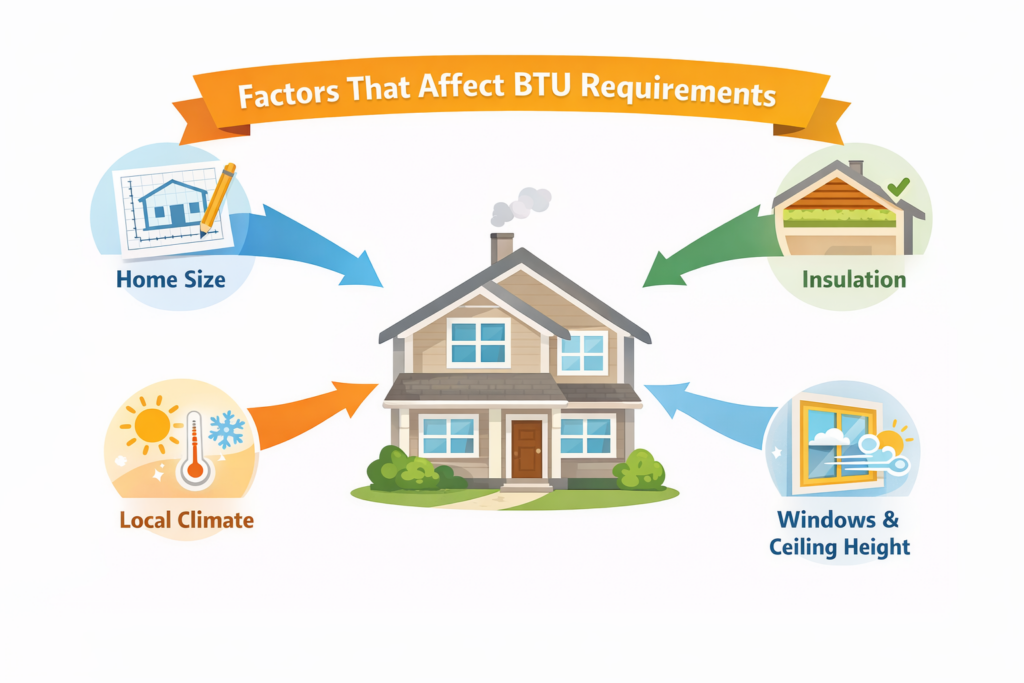
Key Factors That Affect Your Home’s BTU Requirements
Square Footage
Square footage is the starting point for any BTU calculation. Measure all heated or cooled areas, not garages or unfinished basements unless they’re conditioned spaces.
Ceiling Height
BTUs are based on volume, not just floor area. Homes with 9-foot, vaulted, or cathedral ceilings (common throughout the Northeast) require more home heating and cooling capacity than homes with standard 8-foot ceilings.
Climate Zone
Northeast climates demand serious heating power and increasingly reliable cooling. Homes in Vermont and Massachusetts face longer, colder winters, while New Jersey, Pennsylvania, and Delaware experience higher summer cooling loads. Your location directly affects how many BTUs your system needs.
Insulation Quality
Insulation plays a major role in heat loss and heat gain. Many older Northeast homes have under-insulated walls, attics, or crawlspaces, which increases BTU requirements. Improving insulation before replacing equipment can significantly reduce the size and cost of your next system.
Windows and Doors
Windows are a major source of energy loss, especially in older homes with single-pane glass or drafty frames. Large window counts, sliding doors, and poor sealing all increase heating and cooling loads.
Home Orientation and Sun Exposure
Southern-facing homes receive more direct sunlight, which can reduce heating needs in winter but increase air conditioning demand in summer. Shade from trees or nearby buildings can offset this effect.
Occupancy and Appliances
People, lighting, cooking appliances, and electronics all generate heat. Larger households or homes with heavy appliance use require additional cooling capacity.
How to Calculate BTU Requirements: Step by Step
The Basic Formula Method
A simple BTU calculator approach starts with square footage and average BTU-per-square-foot estimates.
For Northeast homes:
- Heating: 40–60 BTUs per square foot
- Cooling: 20–25 BTUs per square foot
A 2,000 sq ft home typically needs:
- 80,000–120,000 BTUs for heating
- 40,000–50,000 BTUs for cooling
(This provides a baseline—not a final answer.)
Adjusting for Your Home’s Variables
You’ll need to adjust upward or downward based on:
- Ceiling heights above 8 feet
- Poor or upgraded insulation
- High window counts or older windows
- Local climate severity
- Number of occupants
Each factor can increase or decrease total BTU needs by 5–30%.
Example Calculation
Consider a 2,000 sq ft colonial home in New York with 9-foot ceilings, average insulation, and 15 windows.
- Base heating estimate: 2,000 × 50 = 100,000 BTUs
- Ceiling height adjustment: +10%
- Window adjustment: +10%
Adjusted heating load: approximately 120,000 BTUs
Cooling calculations would follow the same process with lower per-square-foot values.
Understanding Manual J Load Calculations
Manual J is the industry-standard HVAC load calculation method. Unlike basic BTU calculators, a Manual J evaluation considers dozens of variables, including wall construction, air leakage, duct placement, and local weather data.
DIY calculations are useful for education and planning, but when purchasing new equipment, a professional Manual J calculation ensures precise sizing. HOP Energy performs Manual J load calculations for homeowners throughout Connecticut, New York, Pennsylvania, Massachusetts, New Jersey, Delaware, Rhode Island, and Vermont.
BTU Requirements by Room Size (Quick Reference)
| Room Size | Approximate Square Footage | Heating BTUs Needed* | Cooling BTUs Needed* |
|---|---|---|---|
| Small Room | 100–250 sq ft | 4,000–15,000 BTUs | 4,000–6,000 BTUs |
| Medium Room | 250–400 sq ft | 15,000–25,000 BTUs | 6,000–10,000 BTUs |
| Large Room | 400–600 sq ft | 25,000–35,000 BTUs | 12,000–15,000 BTUs |
| Whole Home | 1,500–3,000+ sq ft | 60,000–120,000+ BTUs | 36,000–60,000+ BTUs |
*BTU ranges assume average insulation, standard ceiling heights, and typical Northeast climate conditions. Homes with high ceilings, older insulation, or large window areas may require higher capacity.
Special Considerations for Northeast Homes
Heating BTU requirements are usually higher than cooling needs due to cold winters. It’s common (and our recommendation) to size heating and cooling equipment separately.
Multi-story homes or houses with additions often benefit from zoned systems, including ductless mini-splits, which allow different BTU capacities per area.
Older homes typically require more capacity than new construction due to less efficient building envelopes.
Using a BTU Calculator Tool
Calculating the right BTU capacity is key to year-round comfort. This calculator uses the K Factor formula—considering square footage, ceiling height, temperature increase, insulation, and climate—to estimate your heating and cooling needs.
BTU Heating & Cooling Calculator
Estimate your home’s heating and cooling needs based on square footage, ceiling height, insulation, and local climate.
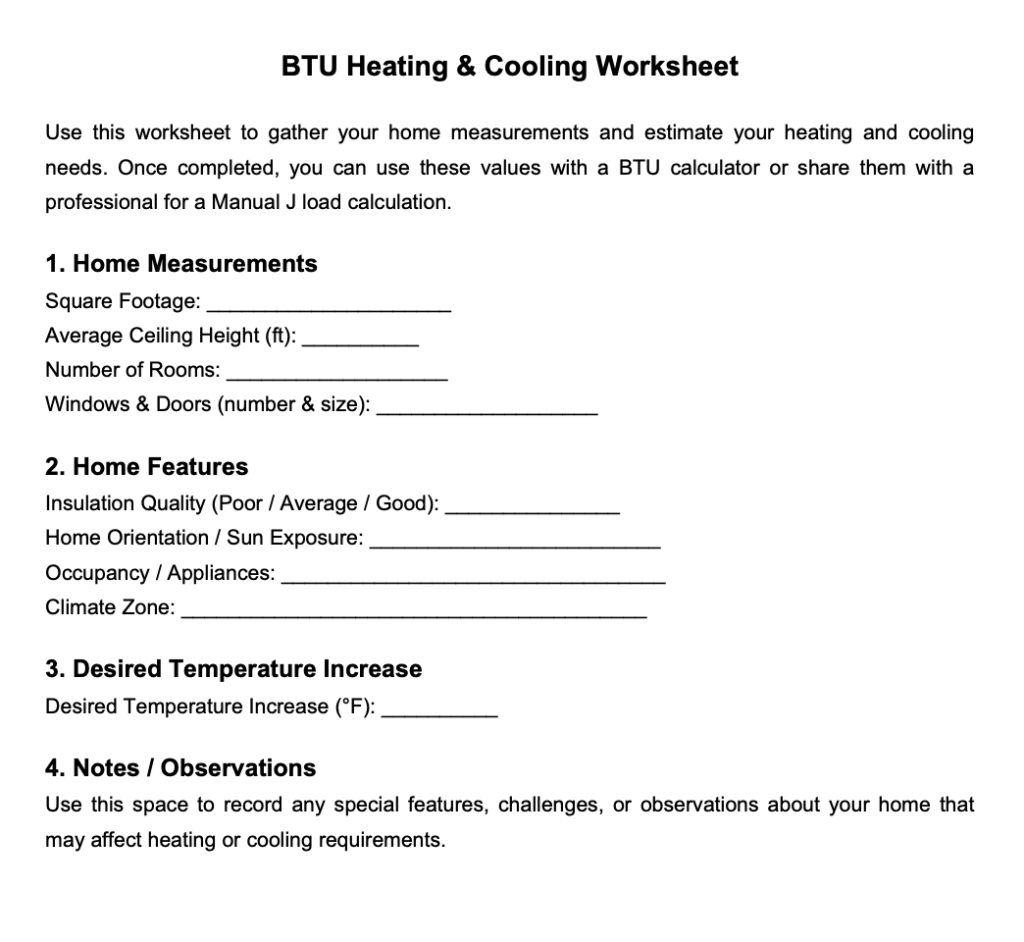
If you plan to gather your measurements and calculate your BTU needs later offline, you can print out this downloadable BTU Heating & Cooling Worksheet (PDF).
Common BTU Calculation Mistakes to Avoid
- Using square footage alone Size is only the baseline—air volume, insulation, and layout matter just as much.
- Ignoring ceiling height Higher ceilings mean more air to heat or cool and higher BTU needs.
- Forgetting windows and doors Window size, quantity, and efficiency directly affect heat loss and gain.
- Relying on generic climate data Northeast weather demands local, not national, assumptions.
- Overlooking home improvements New insulation or windows can significantly change BTU requirements.
- Copying existing system size Older systems were often improperly sized from the start.
When to Call an HVAC Professional
A basic BTU calculation is a helpful starting point, but some situations call for a professional assessment. It’s smart to bring in an HVAC expert if any of the following apply to your home:
- Your home has a complex layout
Split levels, finished basements, or multi-story floor plans can create uneven heating and cooling that simple calculations don’t fully capture. - You use mixed heating systems
Homes with combinations of furnaces, boilers, heat pumps, or supplemental systems require coordinated sizing to avoid comfort gaps. - You’ve completed major renovations or additions
Added square footage, finished attics, or open-concept remodels change heating and cooling loads significantly. - Your home has unique architectural features
Vaulted ceilings, large window walls, sunrooms, or older construction styles can increase BTU requirements beyond standard estimates. - Your system struggles despite “correct” sizing
If comfort issues persist even after careful calculations, airflow, insulation, or duct design may be the real issue. - You’re upgrading to high-efficiency equipment
Whether you are buying a boiler or a furnace (or another equipment type), modern systems are more sensitive to sizing, making professional load calculations essential for performance and long-term savings.
For these scenarios, a professional load calculation ensures your system is sized correctly for your home—not just on paper, but in real-world conditions.
Frequently Asked Questions
How many BTUs per square foot do I need for heating?
Most Northeast homes require 40–60 BTUs per square foot, depending on climate and insulation.
How many BTUs per square foot for cooling?
Cooling needs usually range from 20–25 BTUs per square foot.
Is BTU sizing the same for furnaces, boilers, and AC units?
BTU ratings apply to all, but efficiency and delivery methods differ by system type.
Does fuel type affect BTU calculations?
BTU needs stay the same, but efficiency varies between heating oil, propane, and other fuels. Learn more about heating oil systems and propane heating.
What’s the difference between input and output BTUs?
Input BTUs measure fuel consumption; output BTUs reflect usable heat after efficiency losses.
Should I round up or down when choosing a size?
Avoid rounding up unnecessarily. Proper sizing beats excess capacity every time.
What is a Manual J load calculation and do I need one?
Manual J is the industry standard method for calculating a home’s actual heating and cooling load. It accounts for insulation, window size and orientation, ceiling height, air leakage, duct location, local design temperatures, and internal heat gain. Two homes of identical square footage can have very different loads.
Square footage estimates are useful for sanity-checking a quote. For new construction, a major renovation, or any home where the current system has never worked properly, ask for the calculation and ask to see the report.
What happens if my system is oversized?
It short cycles, meaning it runs in brief bursts and shuts off before completing a full cycle. On the cooling side that leaves the house cold but clammy, because removing humidity requires runtime the system never gets.
On the heating side, short cycling causes temperature swings, uneven room-to-room comfort, and extra wear from repeated starts. Oversizing is by far the more common sizing error, and bigger is not a safety margin.
Can I use the same BTU calculation for heating oil, propane, and natural gas?
Yes. Your home’s heat load doesn’t change with fuel type, but efficiency does. Oil, propane, and gas systems deliver heat differently, so factor in each system’s efficiency when sizing equipment.
Get a Professional Load Calculation from HOP Energy
BTU calculators provide insight, but professional load calculations deliver confidence. HOP Energy combines decades of regional experience with precise sizing to ensure your system is efficient, comfortable, and built for Northeast conditions.
We offer multi-fuel capabilities, including heating oil and propane HVAC systems, plus heating oil delivery (and propane delivery in some locations).
Contact us to schedule a professional HVAC load calculation today and take the guesswork out of heating and cooling your home.