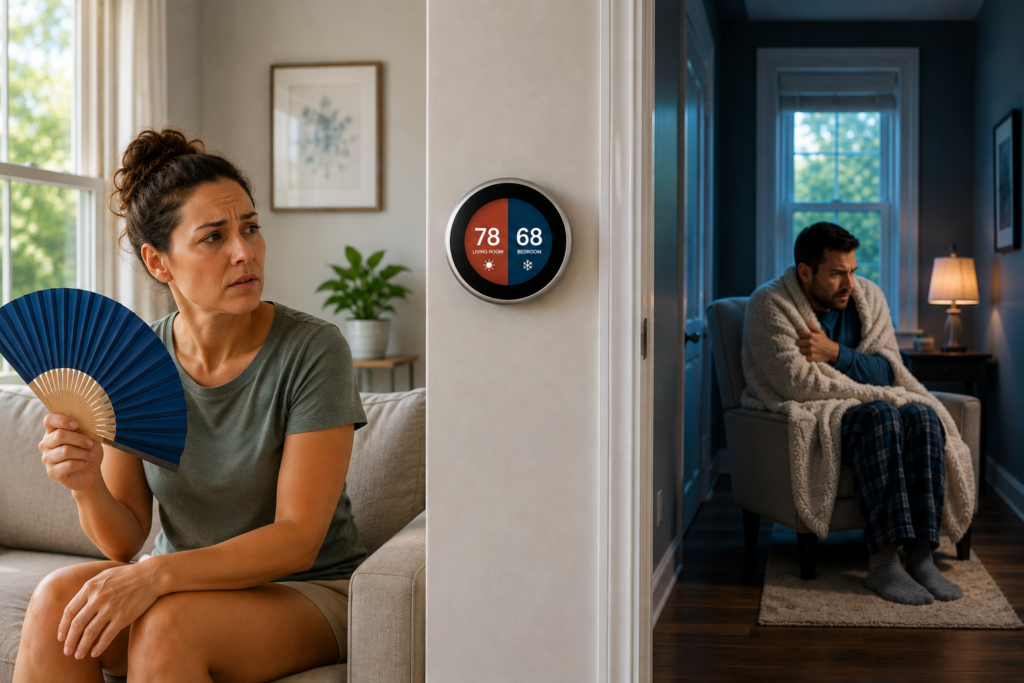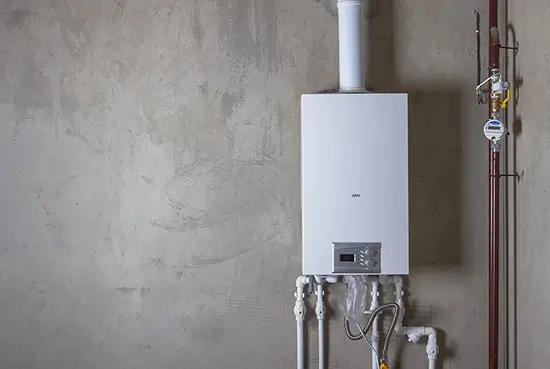

If you are comparing ductless vs central air, you are probably trying to avoid the two most common mistakes homeowners make: paying too much for installation or ending up with a system that does not cool the home evenly.
In our experience working with homeowners on HVAC upgrades, this decision almost always comes down to how the home is built and whether ductwork already exists in good condition.
While there is no universal “best option for everyone,” this guide gives you a clear framework for deciding which system will work best in your home.
How Each System Works In a Real Home
Central air conditioning uses one outdoor unit connected to a central indoor system that pushes cooled air through ductwork. Air is distributed through vents in each room and controlled by a single thermostat or zoned thermostats in upgraded systems.
Ductless mini-split systems use an outdoor condenser connected directly to individual indoor air handlers. Each unit cools a specific room or zone independently and does not require ductwork.
The simplest way to think about it is this:
- Central air distributes air through ducts to the entire home.
- Ductless systems deliver cooling directly to individual rooms/spaces.
Ductless vs Central Air Feature Comparison
| Feature | Central Air | Ductless Mini-Split |
|---|---|---|
| System type | Uses ducts for whole-home cooling | Uses indoor units for each room or zone |
| Best for | Homes with existing ductwork | Homes without ducts or needing zoning |
| Installation | Simple with ducts; complex without | No ducts needed; faster install |
| Upfront cost | Usually lower with ducts | Usually higher for whole-home systems |
| Energy efficiency | Depends on duct condition | Generally higher efficiency |
| Temperature control | Whole-home or zoned upgrade | Room-by-room control |
| Air filtration | Central system filtration | Filters at each unit |
| Heating | Requires separate system | Many models heat and cool |
| Ideal use | Larger homes with duct systems | Older homes, additions, zoning needs |
Which System Is More Cost-Effective?
Central air usually has a lower upfront cost when a home already has ductwork. Installation is more straightforward because the distribution system already exists.
Ductless systems typically have a higher initial cost, especially when multiple indoor units are needed for full-home coverage. However, they avoid duct installation costs entirely, which can be significant in homes that do not already have ductwork.
Over time, ductless systems can produce long-term savings. Ductless mini-splits can reduce energy usage and associated costs because they do not lose conditioned air through ducts and allow for room-by-room control instead of whole-home cooling.
Depending on your location, rebates and incentives for energy-efficient HVAC systems may also help offset installation costs.
Ductless vs. Central Air Cost Comparison
| Cost factor | Central Air | Ductless Mini-Split |
|---|---|---|
| Upfront cost | Lower with existing ducts | Higher for full-home setups |
| Installation | Low with ducts; high if added | No ductwork needed |
| Ductwork | Can add major cost if needed | Not required |
| Energy cost | Depends on duct condition | Often lower due to zoning |
| Efficiency | Drops with leaky ducts | Generally higher efficiency |
| Maintenance | Moderate | Moderate (more units) |
| Rebates | May qualify | Often qualifies |
Energy Efficiency: Where Ductless Has the Edge
Ductless systems are generally more energy efficient than central air systems for three main reasons:
- They avoid duct losses, which can reduce efficiency in homes with older or poorly sealed ductwork.
- They use inverter-driven compressors that adjust output based on demand instead of cycling on and off.
- They allow zoning, meaning you only condition the rooms you are actually using.
Central air systems can still be efficient, but based on what we see in the field, performance depends heavily on duct quality and system design.
Installation: Which Is Easier?
Ductless systems are typically easier and faster to install. They require only a small connection between indoor and outdoor units and do not require ductwork.
Central air installation is simple when ducts already exist and are in good condition. If ductwork must be added or replaced, installation becomes significantly more complex and invasive.
In our field experience, whether the home has ductwork already is often the homeowner’s deciding factor when choosing between central AC and mini-splits. Installation of ductless units is much easier for older homes or renovations where ductwork is absent, limited, or inefficient.
Whole-Home Comfort vs. Zone Control
Efficiency and installation aren’t the only considerations: your personal cooling needs matter too.
Central air systems are best if you prefer whole-home consistency. They work best in homes where the goal is even temperature throughout every room.
Ductless systems are designed for zone control. Each room or area can be set to a different temperature, which is useful for households with varied comfort preferences or uneven heating and cooling patterns.
Indoor Air Quality Considerations
Central air systems generally offer stronger whole-home filtration options because all air passes through one central system. This allows for higher-grade filters and add-on air quality systems.
Ductless systems filter air at each indoor unit. This works well for basic air cleaning, but requires more frequent maintenance and does not offer the same whole-home filtration capacity.
When Ductless Makes More Sense
Ductless systems are often the better choice when:
- The home does not have existing ductwork
- The home has additions, garages, or finished spaces
- There are rooms with uneven temperatures
- Zoned temperature control is a priority
- Avoiding duct installation costs is important
They are especially effective in older homes or partial retrofit situations.
When Central Air Makes More Sense
Central air systems are usually the better fit when:
- The home already has ductwork in good condition
- The goal is consistent, whole-home cooling
- Simplicity of one system is preferred
- The home layout supports even air distribution
- Whole-home air filtration is a primary concern
In these cases, central air is often the most straightforward and cost-efficient solution.
What About Heating? Mini-Splits Do Both
Many ductless systems are also heat pumps, meaning they provide both cooling and heating.
This makes ductless mini-split systems a year-round HVAC solution, rather than just an air conditioner. Many of our customers love mini-splits because they don’t have to maintain separate heating and cooling systems.
Ductless vs. Central Air: Which Should You Choose?
The decision between ductless mini-split vs central air comes down to one factor more than anything else: your home’s structure.
- If you already have functional ductwork and want whole-home cooling, central air is usually the right choice.
- If you do not have ductwork or want zoned comfort and higher efficiency, ductless is usually the better fit.
Again, keep in mind that even if your home has ductwork, the ducts need to be in good condition for central air to be a practical and cost-effective fit. In practice, ductwork condition is one of the most important indicators of long-term system performance and overall cost-effectiveness.
A professional AC evaluation can help determine which system will perform best in your home.
HOP Energy Installs Both Systems
HOP Energy installs both central air and ductless mini-split systems, which means recommendations are based on what actually fits your home rather than a single product type.
In an actual home assessment, we typically evaluate:
- Existing duct system condition
- Home layout and airflow
- Comfort needs
- Energy efficiency goals
- Local climate
Then we recommend the system that makes the most sense for long-term performance and comfort.
Not sure if we serve your area? Check out our service locations. We provide HVAC services across the Northeast, including Connecticut, New York, Pennsylvania, New Jersey, Massachusetts, Rhode Island, Delaware, and Vermont. Our local teams understand the climate and housing styles in each region we serve.
FAQs
Which is better: ductless or central air?
Ductless and central air are both effective, but the better option depends on your home. Central air works best for homes with existing ductwork and whole-home cooling, while ductless is better for homes without ducts or for zoned temperature control.
Is ductless cheaper to run than central air?
Ductless systems are often cheaper to run because they avoid duct energy loss and allow you to cool only the rooms you are using. Actual savings depend on home size, usage, and system efficiency.
Can ductless systems heat a home?
Yes. Most ductless mini split systems are heat pumps, which provide both heating and cooling year round.
Is a mini split cheaper than central air to install?
It depends on the home. Central air is usually cheaper if ductwork already exists, while ductless can be more cost effective if new ductwork would need to be installed.
What is the $5,000 HVAC rule?
The $5,000 HVAC rule is a guideline used to decide between repair and replacement. Multiply the system’s age by the repair cost. If the total exceeds $5,000, replacement may be the better option.
Is it worth replacing central air with ductless?
It depends on duct condition and home layout. Homes with inefficient or missing ductwork often benefit the most from switching to ductless.
How long do ductless and central air systems last?
Both systems can last many years with proper installation and regular HVAC maintenance. Lifespan depends more on installation quality and upkeep than system type.