
Cleaning a Mitsubishi mini split air conditioner is an essential task for homeowners who want to maintain optimal performance and indoor air quality. Mini split systems have become popular among homeowners due to their ability to provide precise heating and cooling control for individual rooms, along with potential energy savings. By following these simple steps, you can ensure that your Mitsubishi mini split remains efficient and effective in keeping your home comfortable.
Step 1: Cut The Power
Turn off the system by turning off the circuit breaker for the indoor and outdoor units.
Step 2: Clean The Filters
Lift the front cover of the indoor unit and remove the filters. Vacuum the filters with a brush attachment. If the filters are heavily soiled, wash them with soap and warm water, ensuring they are completely dry before reinserting them.
Step 3: Clean The Heat Exchanger
Use the brush attachment of your vacuum to clean the delicate fins of the heat exchanger inside the unit.
Step 4: Clean The Fan
Remove the bottom cover and clean the fan blades, fan motor, and cooling coils using a vacuum. If there is visible dust, gently wipe the area with a dry cloth.
Step 5: Clean The Condensate Pan
Wipe up any moisture in the pan located at the bottom of the unit. Ensure the drain hose is functioning correctly. If there is standing water or blockage, use white vinegar to clear it.
Step 6: Remove Debris
To maintain the energy efficiency of a ductless system, you need to clean the loose debris from the indoor and outdoor units.
Step 7: Vacuum and Wash Grilles
Use a vacuum or dry cloth to remove dirt from the heat exchange grilles. If the grilles are heavily soiled, use liquid soap and a garden hose to wash them.
Step 8: Clean Inside Of Housing
Unscrew and remove the top of the outdoor unit, wipe down the fan blades, and vacuum the interior, including the condenser coils.
Step 9: Clean Condensate Pan and Hose
Wipe the drain pan with a cloth and address any mold growth with a bleach solution. Clean the hose with vinegar.
To ensure proper maintenance of all your HVAC systems, including your Mitsubishi mini split air conditioner, consider contacting HOP Energy. Our technicians can inspect your equipment and provide necessary maintenance recommendations. Simply fill out the contact form on our website to schedule an appointment.
Mini-Split FAQs
How often should I clean my mini split?
It depends on which part you are cleaning. Filters need attention every two to four weeks during heavy cooling or heating season. A surface cleaning of the accessible components makes sense every three to six months. A professional deep clean, which reaches the evaporator coil and blower wheel, should happen about once a year.
Push toward the shorter end of every interval if you have pets, if anyone smokes indoors, if you cook frequently in the room with the unit, or if your home runs humid.
What can I clean myself and what needs a technician?
You can safely handle filters, exterior surfaces, the accessible louvers, and wiping down the visible portion of the drain pan. That covers the routine maintenance that keeps a system running well.
Leave the rest to a technician. Evaporator coil fins are soft aluminum that bend permanently under light pressure, and the wrong cleaner will corrode them. Blower wheel cleaning requires partial disassembly and specialized tools. Deep drain line clogs need compressed air or CO2 rather than household methods that push debris further in. Mold treatment without proper chemicals and protective equipment spreads spores instead of removing them.
A reliable rule of thumb: if the job requires you to go past filter access or open any electrical compartment, stop and call a professional. Improper DIY cleaning is one of the most common causes of mini split damage.
Why does my mini split smell like dirty socks or mildew?
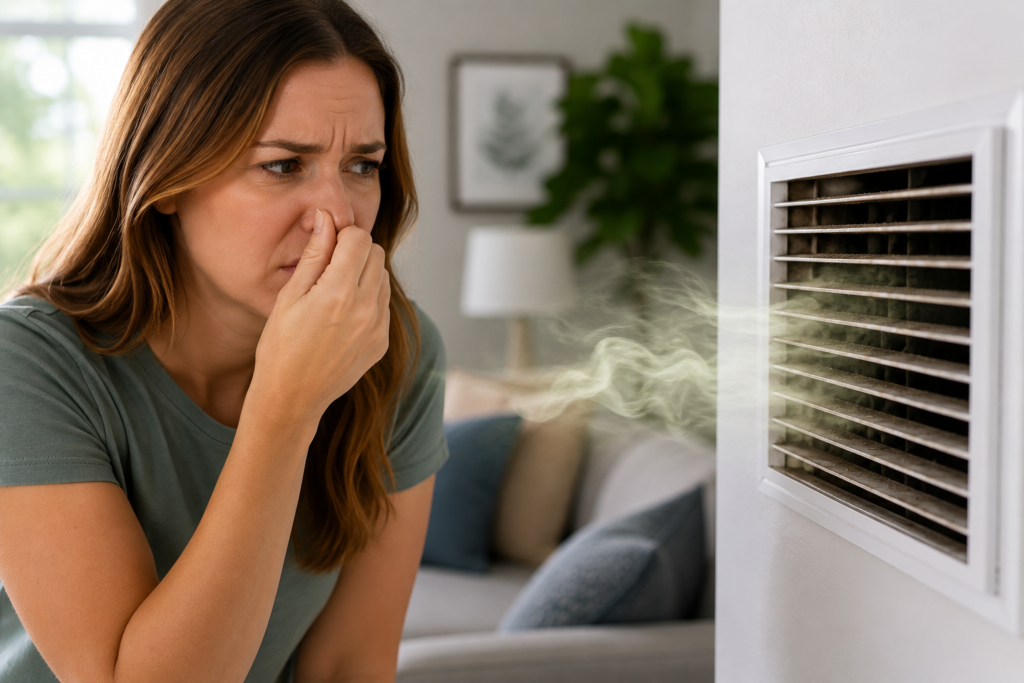
That smell comes from biological growth on the evaporator coil, the blower wheel, or in the drain pan. Mini splits are dark, cool, and damp inside, which is close to ideal conditions for mold and bacteria.
The important thing to understand is that cleaning the filters will not fix it. The source sits deeper in the unit than the filters reach, which is why the smell keeps coming back after a filter wash. The odor is usually strongest in the first few minutes after startup, when airflow pushes accumulated odor into the room.
What is the black debris blowing out of my mini split vents?
That is mold or accumulated biofilm shedding off the blower wheel. Once you are seeing material come out of the vents, buildup inside the unit is significant.
This is not a DIY fix. The blower wheel has to be accessed and cleaned properly, which means partial disassembly. Black streaking on the wall above or below the indoor unit is the same problem showing itself on the outside, and it means the system has been recirculating contaminated air for a while.
How much does professional mini split cleaning cost?
Cost varies by market and by how much work the unit needs, so treat any single number with skepticism. Three factors drive the price: how many indoor heads need service, how contaminated the system is, and whether the blower wheel has to come out.
A routine cleaning on a single head sits at the low end. A multi-zone system that has gone years without service and needs full blower wheel removal sits considerably higher.
When you book service, ask for a written summary of what was actually cleaned. It tells you what you paid for and gives you a baseline for the next visit.
Can I pour bleach in my mini split drain line?
No. Bleach corrodes metal components and can damage the plastics in the drain assembly. Use warm water with a small amount of white vinegar instead, or have a technician clear the line properly.
This is worth distinguishing carefully. Treating visible mold on the surface of a drain pan is not the same as pouring bleach down a drain line, where it sits in contact with components for an extended period. If you are dealing with a clog rather than surface growth, vinegar and a wet/dry vacuum at the exterior drain outlet are the safer approach.
Should I run my mini split on fan mode after cooling?
Yes, and it is one of the highest-value habits you can build. When the compressor shuts off, the evaporator coil stays wet for a long time. That lingering moisture is what feeds mold and produces the musty smell.
Running fan mode for roughly an hour after a cooling cycle dries the coil and cuts that problem off at the source. Many units include a dry mode or a self-clean function that does this automatically, so check whether yours has one before doing it manually.
Why is my mini split leaking water inside the house?
A clogged condensate drain line is the most common cause. When the line backs up, water overflows the drain pan and comes out of the indoor unit. Improper drain line pitch and a cracked drain pan are the other two usual suspects.
Do not wait on this one. Water running down an interior wall gets into drywall, insulation, and flooring fast, and what started as a drain line problem turns into a much larger repair.
Does cleaning my mini split actually lower my energy bill?
It does, and the mechanism is straightforward. A coil coated in dust and grime acts like a blanket over the heat transfer surface. The system has to run longer to reach the temperature you set, which means more runtime and more electricity for the same result.
Dirty filters compound it by restricting airflow, forcing the blower and compressor to work harder. Neither problem announces itself. The unit still runs and still cools, so nothing tells you anything has changed until you compare bills year over year.