
When your air conditioner is running but the air coming out of the vents isn’t cold, it usually feels like the system has “failed.” In reality, most cases of your AC not blowing cold air come down to a few core issues: restricted airflow, poor heat transfer, or components shutting down to protect the system.
In HVAC service calls, this is one of the most common complaints we get during warm weather: “The AC is on, but it’s not cooling.” And in many cases when the air conditioner is not cooling, the system is still technically running, but it just isn’t able to move heat out of the home effectively.
Here’s how technicians actually work through this issue in the field, from simplest causes to more serious repairs.
Table of Contents
Check the Thermostat First
Before assuming something is wrong with the system, confirm the thermostat is actually calling for cooling.
Check:
- Set to COOL (not heat or fan-only mode)
- Fan set to AUTO (not ON)
- Temperature set at least 3–5 degrees below room temperature
- Thermostat is responsive (not dim or unresponsive)
Field insight:
After power outages or seasonal changeovers, incorrect fan settings are one of the most frequent “AC not cooling” service calls. The system is running normally, but it’s just circulating uncooled air continuously.
If settings are correct and there’s still no cooling after 5–10 minutes, move on.
Airflow Problems (Most Common Cause)
If there’s one category that causes most cooling complaints, it’s airflow restriction.
When airflow drops, the system can’t move enough warm air over the evaporator coil. That leads to poor cooling, and often icing as well.
The most common causes:
- Dirty or clogged air filter
- Closed or blocked supply vents
- Blocked return air grille
- Restrictive or leaking ductwork
What technicians look for:
We’re checking whether the system can “breathe.” If airflow is weak at multiple vents, the problem is almost always upstream.
Why this matters:
Restricted airflow can cause the evaporator coil to get too cold and freeze, which then worsens airflow until cooling stops completely.
Simple fix:
Replace the air filter and ensure vents are open and unobstructed.
If airflow improves but cooling does not fully return, the system may already be dealing with icing or another secondary issue.
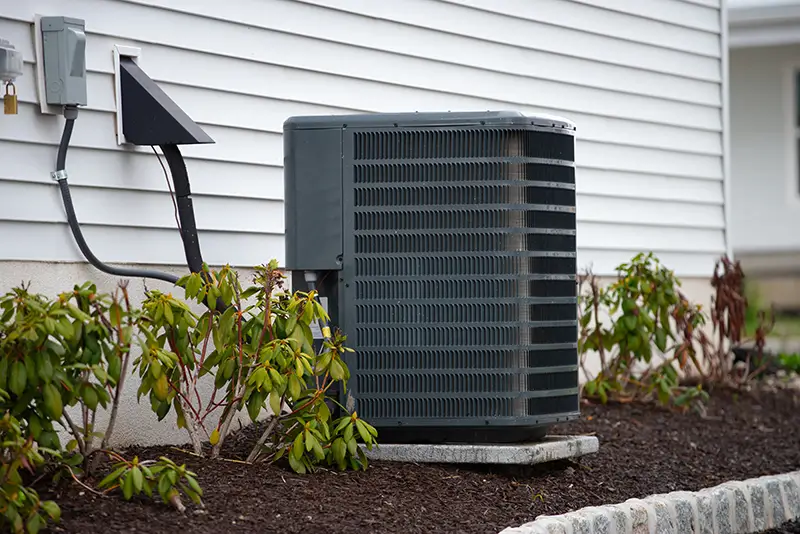
Outdoor Unit Not Releasing Heat Properly
Your AC doesn’t create cold air; it removes heat from inside and releases it outside.
If the outdoor unit can’t dump that heat efficiently, indoor cooling drops quickly.
Common field issues:
- Dirt or grass clogging condenser coil
- Shrubs or fencing restricting airflow
- Debris buildup around the unit
- Recirculating hot air due to tight installation space
Technician check:
We look at discharge air temperature. If the unit is running but not expelling noticeably warm air, heat transfer is compromised.
What you can safely do:
- Turn off power to the unit
- Clear debris within ~2 feet
- Gently rinse condenser coil (low pressure only)
If performance doesn’t improve, the issue is likely internal (refrigerant, coil, or compressor-related).
Frozen Evaporator Coil (Symptom, Not the Root Problem)
A frozen indoor coil is one of the most misunderstood AC issues.
It is almost always the result of another problem, usually airflow-related.
Common triggers:
- Dirty air filter (most frequent)
- Low airflow from ducts or blower issues
- Sometimes low refrigerant levels
What it looks like:
- Airflow becomes progressively weaker
- System runs continuously but cooling drops off
- Ice may form on refrigerant lines or indoor coil
- Eventually no cool air reaches the vents
What to do:
Turn the system OFF and set the fan to ON to thaw the coil.
Important technician rule:
If the system freezes again after thawing, stop troubleshooting. That indicates an underlying mechanical or refrigerant issue.
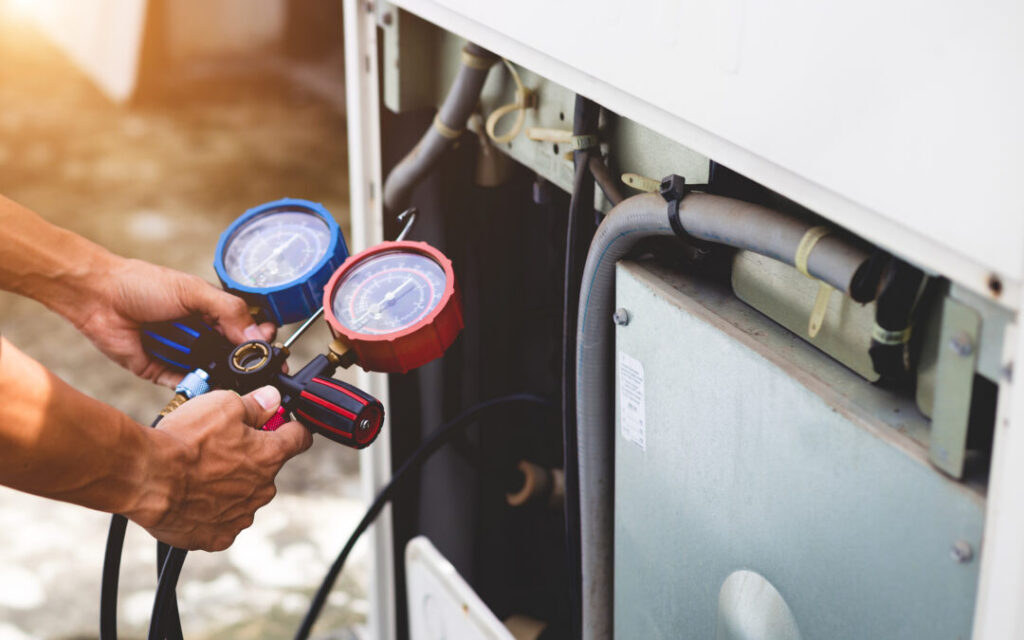
Refrigerant Problems (Not DIY-Repairable)
Refrigerant is the substance that absorbs heat from inside your home and releases it outside.
If levels are low, the system cannot cool effectively.
Field symptoms:
- AC runs constantly with little or no cooling
- Ice forming on copper lines or outdoor unit
- Hissing or bubbling sounds
- Gradual loss of cooling performance over time
Key fact:
Refrigerant is a sealed system. If it’s low, there is almost always a leak.
This requires:
- Leak detection tools
- EPA-certified handling
- Repair and recharge procedures
Running the system in this condition can damage the compressor.
Electrical Issues
Sometimes the system appears to be running, but key components aren’t fully operating.
Check:
- Tripped breaker in electrical panel
- Outdoor disconnect switch
- Air handler power switch
Technician rule:
We reset once. If it trips again, we stop immediately.
Repeated tripping usually indicates:
- Compressor strain
- Electrical fault
- Capacitor or wiring failure
Clogged Condensate Drain Line
Your air conditioner removes humidity as it cools, and that moisture drains through a condensate line.
If the line becomes clogged, water can back up and trigger a safety switch that affects system operation.
Signs include:
- Water around the indoor unit
- Musty smells near vents
- The system shutting off unexpectedly or not cooling properly
Some minor clogs can be cleared, but recurring issues usually require professional service.
Heat Pump-Specific Issues
If your system is a heat pump, additional behaviors can affect cooling:
- Reversing valve stuck in heating mode
- System stuck in defrost cycle
- Control board communication issues
Field note:
Heat pump issues often mimic refrigerant or compressor problems, which is why proper diagnostics matter before replacing parts.
Compressor Issues
Compressor issues are the least common cause of an air conditioner not cooling, but they are the most serious. The compressor circulates refrigerant through the system. If it fails, cooling performance drops significantly or stops entirely.
Signs:
- Outdoor unit hums but doesn’t cool
- Breaker trips repeatedly
- System struggles to start or cycle properly
- No meaningful temperature change indoors
Field reality:
We only diagnose compressor failure after ruling out airflow, refrigerant, and electrical issues.
Repair vs replacement depends on:
- System age
- Refrigerant type
- Overall system condition
When to Stop DIY Troubleshooting
From a technician standpoint, here’s the clean cutoff point when you should call for service:
- Filter and thermostat checks don’t restore cooling
- System freezes more than once
- Breaker continues to trip
- Outdoor unit runs but doesn’t cool
- Airflow drops and does not recover
- Refrigerant or compressor issues are suspected
At this stage, continued troubleshooting usually delays repair rather than solving the problem.
Maintenance Matters More Than Most Homeowners Realize
Most AC cooling failures don’t happen suddenly. They develop over time due to:
- Restricted airflow
- Dirty coils
- Low refrigerant from slow leaks
- Drain line buildup
- Electrical wear
Routine maintenance is the best way to prevent most “AC not cooling” problems before they start. HOP Energy offers professional AC tune-ups and maintenance designed to catch airflow, refrigerant, and electrical issues early, before they turn into mid-season breakdowns.
A professional tune-up typically includes:
- Coil cleaning
- Airflow testing
- Refrigerant level check
- Electrical inspection
- Drain line clearing
This is where many of the issues in this article are caught early.
When to Call HOP Energy
If your AC is not blowing cold air after checking the basics, a diagnostic visit can quickly identify whether it’s a simple repair or a deeper system issue.
HOP Energy technicians handle full-system HVAC diagnostics, repair, and maintenance, including refrigerant, electrical, and airflow issues. Our technicians are trained to diagnose issues quickly and fix the root cause, not just the symptom.
Learn more about our HVAC and AC repair services.
FAQs
Why is my AC running but not cooling the house?
Most commonly, this is due to airflow restriction, frozen coils, refrigerant issues, or electrical problems preventing full system operation.
Should I turn off my AC if it’s not cooling?
Yes, especially if you suspect freezing or weak airflow. Running it in that condition can worsen damage.
Why is my AC blowing warm air instead of cold?
Usually this is caused by airflow issues, refrigerant loss, or a system that cannot properly reject heat outdoors.
How do HVAC technicians diagnose this quickly?
We start with airflow, then temperature difference testing, followed by refrigerant and electrical diagnostics. Most issues are identified within the first stages of inspection.
What is the 3-minute rule for air conditioners?
The 3-minute rule refers to waiting a few minutes after turning your AC off before turning it back on. This allows system pressure to stabilize and helps prevent damage to the compressor.
How do I reset my air conditioner?
To reset your AC, turn off the thermostat, shut off power at the breaker, wait about one to two minutes, then restore power and turn the system back on. If the problem continues after a reset, it may require professional service.