Why Your AC Smells Musty and How to Fix It

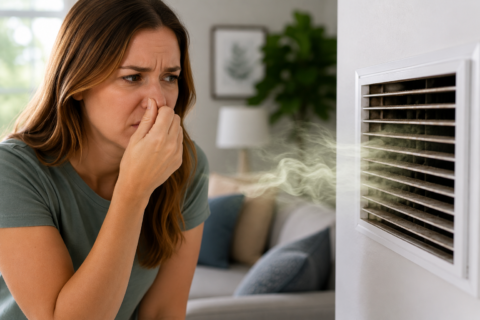
woman covering her nose from a musty smell coming from her AC air duct

If your AC smells musty when it turns on, moisture is usually to blame. Mold, mildew, standing water, or restricted airflow can all create unpleasant odors that spread through your home whenever your air conditioner runs. Homeowners often notice a musty smell at the start of cooling season after moisture has had time to accumulate inside the system.

Gas Smell Warning: When to Call 911

Before troubleshooting a musty AC smell, it’s important to recognize one odor that should never be ignored: natural gas. Often compared to the smell of rotten eggs or sulfur, a gas leak is an emergency. If you notice this smell, leave the home immediately and call 911 or your gas utility provider from a safe location.

A musty smell is typically not an emergency, but it is a sign that something in your HVAC system needs attention.

Why Does My AC Smell Musty?

Most musty smells from air conditioners are caused by excess moisture somewhere in the system. When water collects in drain pans, condensate lines, ductwork, or on HVAC components, mold and mildew can develop and create unpleasant odors.

Identifying the source of the moisture is the first step toward eliminating the smell.

Common Causes of a Musty AC Smell
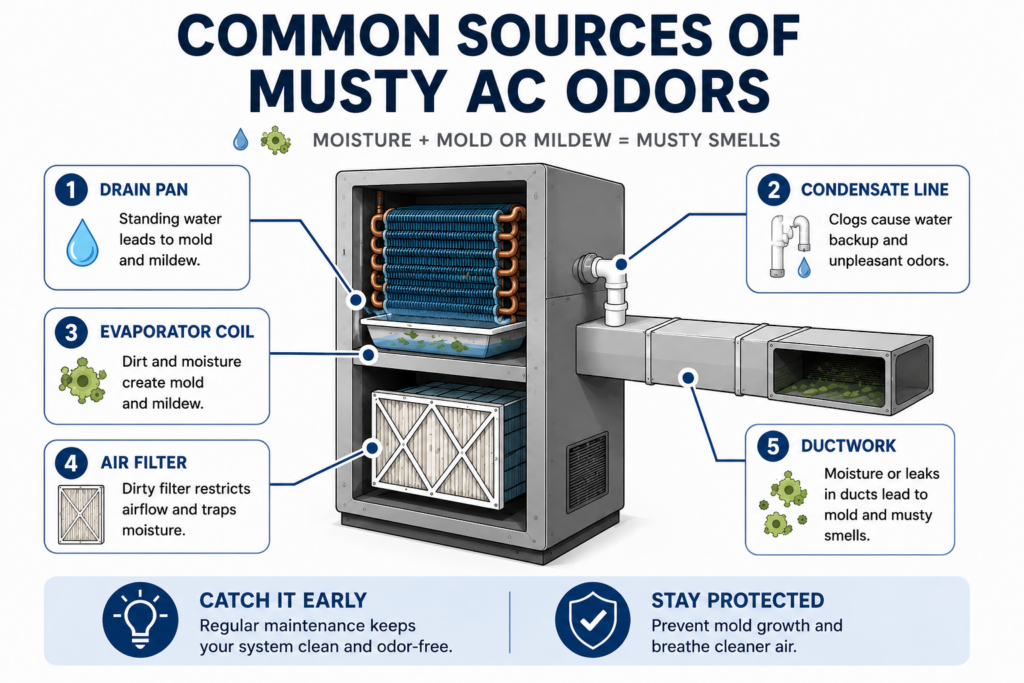
graphic showing common sources for musty AC odors

Full or Stagnant Drain Pan

As your air conditioner removes humidity from the air, condensation collects in a drain pan beneath the evaporator coil. If water remains in the pan for too long, mold and mildew can begin to grow.

Check the drain pan for standing water and visible buildup. Cleaning or replacing a damaged pan may help eliminate the odor.

Clogged Condensate Drain Line

The condensate drain line carries moisture away from your HVAC system. Over time, algae, mold, dirt, and debris can clog the line and prevent proper drainage.

A clogged drain line can often be cleared by flushing it with a mixture of water and vinegar. Signs of a blockage may include water near the indoor unit, musty odors, or a full drain pan.

Mold or Mildew in Ductwork

If the musty smell seems strongest when air is blowing through your vents, mold or mildew may be growing inside your ductwork.

Because duct systems are difficult to access and clean properly, professional duct cleaning is usually the safest and most effective solution. An HVAC technician can also identify moisture problems that may be allowing mold to return.

Dirty Air Filter Causing a Frozen Evaporator Coil

A clogged air filter restricts airflow across the evaporator coil. When airflow becomes too limited, condensation on the coil can freeze instead of draining away properly. The first sign of a dirty air filter can be that your AC system stops blowing cold air.

As the ice melts, excess moisture can contribute to mold growth and musty odors. Replacing the air filter regularly helps maintain airflow and prevent this issue.
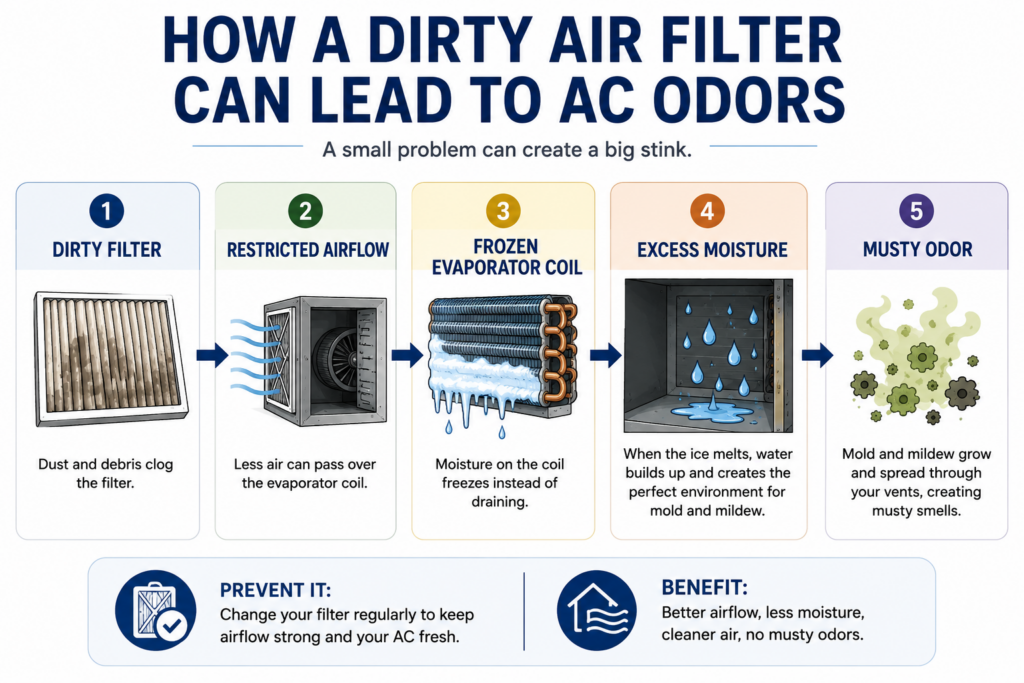
graphic showing how a dirty air filter can lead to AC odors

Dirty Evaporator Coils

Evaporator coils are constantly exposed to moisture. Over time, dust, dirt, pet dander, and other contaminants can accumulate on the coil surface, creating an ideal environment for mold and mildew.

Dirty coils can also reduce cooling efficiency and force your AC system to work harder. Professional coil cleaning removes buildup, improves airflow, and helps restore indoor air quality. 

Leaky Ductwork Allowing Humid Air Inside

Leaks in your ductwork can pull humid air into the system from attics, crawl spaces, and other unconditioned areas. Excess humidity creates the perfect conditions for mold growth and musty odors.

A professional HVAC technician can inspect the duct system and seal leaks to help prevent future moisture problems.

Does a Musty AC Make You Sick?

A musty-smelling air conditioner does not automatically mean you will become sick, but it can indicate the presence of mold or mildew. Exposure to mold spores may trigger upper respiratory symptoms such as sneezing, coughing, congestion, headaches, irritated eyes, or throat irritation.

People with asthma, allergies, or other respiratory conditions may be especially sensitive to poor indoor air quality. Left untreated, mold growth can continue to spread within the system and negatively affect indoor air quality throughout the home. Addressing musty odors promptly can help reduce potential health concerns and improve overall comfort.

Window Air Conditioner Smells Musty

Window air conditioners are especially prone to musty odors because they collect moisture in a compact space. Mold and mildew can develop quickly if the unit is not cleaned regularly.

Start by removing and cleaning the filter. Next, inspect the evaporator coils and drain openings for dirt, debris, or mold growth. A coil cleaner designed for air conditioners can help remove buildup.

In some cases, replacing an aging or inefficient AC unit may be more cost-effective than repeated repairs.

How to Prevent a Musty Smell in Your AC

A few simple maintenance habits can help prevent musty odors from developing in the first place:

  • Replace air filters regularly.
  • Schedule an annual AC tune-up before cooling season.
  • Keep the condensate drain line clear.
  • Address water leaks promptly.
  • Consider a UV air purifier to help reduce mold growth within the HVAC system.
  • Keep indoor humidity levels under control.

Routine maintenance allows HVAC technicians to identify small issues before they become larger problems. Preventive service can also improve system efficiency, indoor air quality, and overall comfort.

Learn more about how your AC affects the air quality in your home by reading our article: The Hidden Link Between Your A/C and Indoor Air Quality

When to Call an HVAC Professional

If your AC still smells musty after replacing the filter and checking for obvious moisture issues, it’s time to call a professional. Persistent odors often indicate mold growth, dirty coils, ductwork issues, or drainage problems that require specialized equipment to diagnose and repair.

Whether you need AC repair, maintenance, or a complete system replacement, HOP Energy’s HVAC technicians can identify the source of the odor and recommend the most effective solution. We can also recommend indoor air quality solutions that help reduce mold, mildew, and airborne contaminants throughout your home.

Frequently Asked Questions

Why does my AC only smell musty for the first few minutes after it turns on?

Dust, moisture, and small amounts of mold or mildew can accumulate while the system is not running. When you turn the AC on, those odors may be pushed through the ductwork and into your home.

Is it safe to run my AC if it smells like mildew?

It is generally safe for a short period, but the odor should not be ignored. A mildew smell often indicates excess moisture or mold growth that should be addressed before it worsens.

How do I get rid of a musty smell from my air conditioner?

Start by replacing the air filter and checking for standing water in the drain pan. If the odor persists, the issue may involve dirty coils, ductwork, or drainage components that require professional service.

Can a dirty air filter cause a musty smell?

Yes. A dirty air filter can restrict airflow, contribute to frozen evaporator coils, and create conditions that allow moisture and mold growth to develop.

What does mold in an AC unit smell like?

Most homeowners describe mold in an AC system as damp, musty, earthy, or similar to mildew. The smell is often strongest when the system first starts running.

Why Is My Air Conditioner Not Blowing Cold Air?

Overheated couple beside a fan, a reminder to schedule seasonal propane and AC maintenance

When your air conditioner is running but the air coming out of the vents isn’t cold, it usually feels like the system has “failed.” In reality, most cases of your AC not blowing cold air come down to a few core issues: restricted airflow, poor heat transfer, or components shutting down to protect the system.

In HVAC service calls, this is one of the most common complaints we get during warm weather: “The AC is on, but it’s not cooling.” And in many cases when the air conditioner is not cooling, the system is still technically running, but it just isn’t able to move heat out of the home effectively.

Here’s how technicians actually work through this issue in the field, from simplest causes to more serious repairs.

Table of Contents

Check the Thermostat First

Before assuming something is wrong with the system, confirm the thermostat is actually calling for cooling.

Check:

  • Set to COOL (not heat or fan-only mode)
  • Fan set to AUTO (not ON)
  • Temperature set at least 3–5 degrees below room temperature
  • Thermostat is responsive (not dim or unresponsive)

Field insight:
After power outages or seasonal changeovers, incorrect fan settings are one of the most frequent “AC not cooling” service calls. The system is running normally, but it’s just circulating uncooled air continuously.

If settings are correct and there’s still no cooling after 5–10 minutes, move on.

Airflow Problems (Most Common Cause)

If there’s one category that causes most cooling complaints, it’s airflow restriction.

When airflow drops, the system can’t move enough warm air over the evaporator coil. That leads to poor cooling, and often icing as well.

The most common causes:

  • Dirty or clogged air filter
  • Closed or blocked supply vents
  • Blocked return air grille
  • Restrictive or leaking ductwork

What technicians look for:

We’re checking whether the system can “breathe.” If airflow is weak at multiple vents, the problem is almost always upstream.

Why this matters:

Restricted airflow can cause the evaporator coil to get too cold and freeze, which then worsens airflow until cooling stops completely.

Simple fix:

Replace the air filter and ensure vents are open and unobstructed.

If airflow improves but cooling does not fully return, the system may already be dealing with icing or another secondary issue.

Outdoor Unit Not Releasing Heat Properly

Your AC doesn’t create cold air; it removes heat from inside and releases it outside.

If the outdoor unit can’t dump that heat efficiently, indoor cooling drops quickly.

Common field issues:

  • Dirt or grass clogging condenser coil
  • Shrubs or fencing restricting airflow
  • Debris buildup around the unit
  • Recirculating hot air due to tight installation space

Technician check:

We look at discharge air temperature. If the unit is running but not expelling noticeably warm air, heat transfer is compromised.

What you can safely do:

  • Turn off power to the unit
  • Clear debris within ~2 feet
  • Gently rinse condenser coil (low pressure only)

If performance doesn’t improve, the issue is likely internal (refrigerant, coil, or compressor-related).

Frozen Evaporator Coil (Symptom, Not the Root Problem)

A frozen indoor coil is one of the most misunderstood AC issues.

It is almost always the result of another problem, usually airflow-related.

Common triggers:

  • Dirty air filter (most frequent)
  • Low airflow from ducts or blower issues
  • Sometimes low refrigerant levels

What it looks like:

  • Airflow becomes progressively weaker
  • System runs continuously but cooling drops off
  • Ice may form on refrigerant lines or indoor coil
  • Eventually no cool air reaches the vents

What to do:

Turn the system OFF and set the fan to ON to thaw the coil.

Important technician rule:
If the system freezes again after thawing, stop troubleshooting. That indicates an underlying mechanical or refrigerant issue.

Refrigerant Problems (Not DIY-Repairable)

Refrigerant is the substance that absorbs heat from inside your home and releases it outside.

If levels are low, the system cannot cool effectively.

Field symptoms:

  • AC runs constantly with little or no cooling
  • Ice forming on copper lines or outdoor unit
  • Hissing or bubbling sounds
  • Gradual loss of cooling performance over time

Key fact:

Refrigerant is a sealed system. If it’s low, there is almost always a leak.

This requires:

  • Leak detection tools
  • EPA-certified handling
  • Repair and recharge procedures

Running the system in this condition can damage the compressor.

Electrical Issues

Sometimes the system appears to be running, but key components aren’t fully operating.

Check:

  • Tripped breaker in electrical panel
  • Outdoor disconnect switch
  • Air handler power switch

Technician rule:

We reset once. If it trips again, we stop immediately.

Repeated tripping usually indicates:

  • Compressor strain
  • Electrical fault
  • Capacitor or wiring failure

Clogged Condensate Drain Line

Your air conditioner removes humidity as it cools, and that moisture drains through a condensate line.

If the line becomes clogged, water can back up and trigger a safety switch that affects system operation.

Signs include:

  • Water around the indoor unit
  • Musty smells near vents
  • The system shutting off unexpectedly or not cooling properly

Some minor clogs can be cleared, but recurring issues usually require professional service.

Heat Pump-Specific Issues

If your system is a heat pump, additional behaviors can affect cooling:

  • Reversing valve stuck in heating mode
  • System stuck in defrost cycle
  • Control board communication issues

Field note:
Heat pump issues often mimic refrigerant or compressor problems, which is why proper diagnostics matter before replacing parts.

Compressor Issues

Compressor issues are the least common cause of an air conditioner not cooling, but they are the most serious. The compressor circulates refrigerant through the system. If it fails, cooling performance drops significantly or stops entirely.

Signs:

  • Outdoor unit hums but doesn’t cool
  • Breaker trips repeatedly
  • System struggles to start or cycle properly
  • No meaningful temperature change indoors

Field reality:

We only diagnose compressor failure after ruling out airflow, refrigerant, and electrical issues.

Repair vs replacement depends on:

  • System age
  • Refrigerant type
  • Overall system condition

When to Stop DIY Troubleshooting

From a technician standpoint, here’s the clean cutoff point when you should call for service:

  • Filter and thermostat checks don’t restore cooling
  • System freezes more than once
  • Breaker continues to trip
  • Outdoor unit runs but doesn’t cool
  • Airflow drops and does not recover
  • Refrigerant or compressor issues are suspected

At this stage, continued troubleshooting usually delays repair rather than solving the problem.

Maintenance Matters More Than Most Homeowners Realize

Most AC cooling failures don’t happen suddenly. They develop over time due to:

  • Restricted airflow
  • Dirty coils
  • Low refrigerant from slow leaks
  • Drain line buildup
  • Electrical wear

Routine maintenance is the best way to prevent most “AC not cooling” problems before they start. HOP Energy offers professional AC tune-ups and maintenance designed to catch airflow, refrigerant, and electrical issues early, before they turn into mid-season breakdowns.

A professional tune-up typically includes:

  • Coil cleaning
  • Airflow testing
  • Refrigerant level check
  • Electrical inspection
  • Drain line clearing

This is where many of the issues in this article are caught early.

When to Call HOP Energy

If your AC is not blowing cold air after checking the basics, a diagnostic visit can quickly identify whether it’s a simple repair or a deeper system issue.

HOP Energy technicians handle full-system HVAC diagnostics, repair, and maintenance, including refrigerant, electrical, and airflow issues. Our technicians are trained to diagnose issues quickly and fix the root cause, not just the symptom.

Learn more about our HVAC and AC repair services.

FAQs

Why is my AC running but not cooling the house?

Most commonly, this is due to airflow restriction, frozen coils, refrigerant issues, or electrical problems preventing full system operation.

Should I turn off my AC if it’s not cooling?

Yes, especially if you suspect freezing or weak airflow. Running it in that condition can worsen damage.

Why is my AC blowing warm air instead of cold?

Usually this is caused by airflow issues, refrigerant loss, or a system that cannot properly reject heat outdoors.

How do HVAC technicians diagnose this quickly?

We start with airflow, then temperature difference testing, followed by refrigerant and electrical diagnostics. Most issues are identified within the first stages of inspection.

What is the 3-minute rule for air conditioners?

The 3-minute rule refers to waiting a few minutes after turning your AC off before turning it back on. This allows system pressure to stabilize and helps prevent damage to the compressor.

How do I reset my air conditioner?

To reset your AC, turn off the thermostat, shut off power at the breaker, wait about one to two minutes, then restore power and turn the system back on. If the problem continues after a reset, it may require professional service.

Dear HOP: How Should I Prepare My AC System for Spring?

Homeowner covering an outdoor AC unit for fall, protecting AC and indoor air quality

Homeowners hear all kinds of advice about their cooling systems and how to prepare for the upcoming warm weather. We asked the experts at HOP Energy to provide the essential steps to keep your home’s cooling system running smoothly all summer long.

How Should I Prepare My Home Cooling System for Spring?

Spring is one of the best times to prepare your home’s air conditioning system before the heat of summer arrives. From a technician’s perspective, a little preventative work now can help ensure your AC runs efficiently and reliably when temperatures start climbing.

Here are a few things we recommend homeowners do in the spring:

Replace or clean your air filters. Dirty filters restrict airflow and force your AC system to work harder, which can reduce efficiency and cooling performance.

Schedule a spring AC tune-up. A professional inspection helps ensure your cooling system is ready for summer. Technicians will check refrigerant levels, electrical components, and system performance before peak demand begins.

Clear debris around your outdoor condenser unit. Leaves, dirt, and branches can build up around the outdoor AC unit over the winter. Keeping at least two feet of clear space around the condenser helps maintain proper airflow and efficiency.

Test your thermostat in cooling mode. Turn your AC on briefly during spring to confirm it starts properly and is delivering cool air. Catching small issues early can prevent breakdowns when you need cooling most.

Check vents and registers throughout your home. Make sure furniture, rugs, or curtains are not blocking airflow, allowing your AC system to distribute cool air evenly.

From our experience, homeowners who take a few simple steps in the spring typically experience fewer repairs, better efficiency, and more reliable cooling when summer arrives. Preparing your AC system now helps ensure your home stays comfortable when the first heat wave hits

Dear HOP: Your Home Comfort Questions Answered

Introducing Dear HOP — a candid look at the real questions our customers ask us every day and the honest answers they get from our trusted HOP Energy team. From fuel delivery to home comfort tips, this article offers practical advice based on real conversations, helping you stay informed, prepared, and comfortable all year long.

Q: What kind of financing does HOP have for a new AC or mini-split system? I need a new one and I'm not sure I can hold out until end of summer, but money is a bit tight.

A: HOP Energy offers a variety of flexible financing options and payment plans for ALL our equipment, including new AC and mini-split systems, so you can get the comfort you need without delay. Our team can walk you through payment plans that fit your budget, including zero-down and low monthly payment options for qualified customers. We recommend speaking directly with one of our knowledgeable reps, who will review your home’s needs, explain your system choices, and guide you through the financing options that work best for you. Let’s schedule a free in-home or phone consultation to get you started whenever you’re ready.

Q: I have an AC window unit now, but it’s loud and getting old and expensive. A friend recommended I replace it with a mini-split, but don’t know a lot about them. Are they a good choice?

A: Great question, and you’re definitely not alone in thinking about switching! Many homeowners are switching from old, noisy window units to modern mini-split systems because they’re much quieter, more energy-efficient, and can cool or heat specific rooms effectively. They also free up your windows, look cleaner inside your home, and help lower energy costs while keeping you comfortable. Best of all, you won’t have to go through the hassle of installing and removing your AC unit every year—mini-splits stay in place and work year-round. Plus, many of our models provide heating, giving you year-round comfort all in one system. One of our reps would be happy to take a look at your home and walk you through how a mini-split could work for your space, including system options and financing if needed.

Q: Is summertime a good time to stock up on heating oil? I don't need it right now, but are prices cheaper during summer?

A: Many customers in the Northeast do choose to stock up on heating oil during the summer because prices often tend to be lower when demand is down. While prices can still fluctuate based on market conditions, topping off your tank in the off-season can help you be prepared for fall and winter before the rush, while potentially saving on your cost per gallon. Plus, it’s one less thing to worry about when the cold weather returns!

About HOP Energy

HOP Energy is a trusted, full-service energy provider serving homes and businesses across the Northeast with reliable heating oil delivery, propane, and expert HVAC services. With a focus on local service, energy efficiency, and customer comfort, HOP Energy is here to help you stay warm, comfortable, and prepared all year long.

Why Energy Efficiency Drops in High Heat—And How to Fight Back

It seems logical to assume that your air conditioner works best when it’s needed most—during the hottest days of summer. After all, that’s when it’s running the hardest, right?

But here’s the counterintuitive truth: your A/C is actually less efficient when temperatures soar. In fact, once outdoor temps climb above 90°F, most cooling systems start to struggle—not just in keeping your home comfortable, but in doing so efficiently.

Let’s explore why this happens, and what smart homeowners can do to protect their comfort, energy bill, and system health.

Table of Contents

The Science: Why Your A/C Struggles in Extreme Heat

Your central air system relies on refrigerant—usually a chemical like R-32—to absorb heat from inside your home and transfer it outside. This process depends on a delicate balance of pressure, airflow, and heat exchange.

As outdoor temperatures rise, that balance is harder to maintain. The heat transfer process becomes less efficient, because the condenser unit (outside) is trying to dump heat into air that’s already hot. It’s like trying to cool down in a sauna—it just doesn’t work as well.

The result? Your A/C runs longer cycles, uses more electricity, and delivers less cooling. That means:

  • Higher energy bills
  • More strain on the system (leading to breakdowns)
  • Less comfort inside your home

It’s a triple threat, and one many homeowners don’t realize it is happening—until they see their utility bill or feel hot spots indoors.

Homeowner checking a smart thermostat, energy efficiency in high heat

Small Changes That Make a Big Difference

The good news? There are simple, smart ways to help your A/C stay cooler under pressure—even during a heatwave.

  1. Shade Your Outdoor Unit
    Direct sunlight on your condenser can add 10° or more to the operating temp. Planting a small shrub (with room for airflow) or adding a vented shade barrier can keep the unit cooler and more efficient.
  2. Install a Smart Thermostat
    A programmable or smart thermostat prevents your A/C from overworking by adjusting temperatures when no one’s home. Some models even “learn” your patterns and optimize cooling schedules automatically.
  3. Use Zone Cooling
    Closing vents in unused rooms or using ductless mini-split systems can allow you to cool only the spaces you need. This reduces system load and maximizes comfort where you actually spend time.
  4. Maintain the System
    Dirty coils, clogged filters, and low refrigerant can magnify the heat problem. A professional tune-up ensures your system is running at peak performance—even in a heatwave.

How HOP Energy Helps You Stay Efficient

At HOP Energy, we don’t just fill your tank, we keep your whole home running smarter. Our Cooling System Reviews include a full A/C performance check, coil cleaning, filter replacement, and expert recommendations for upgrades like smart thermostats or zoned cooling options.

We’ll help you spot problems before they become breakdowns—and optimize your system for maximum efficiency during the hottest months of the year.

Maximize Efficiency—Book a Cooling System Review Today

Don’t let your A/C lose the battle against summer heat. Take control, stay cool, and lower your energy bills with HOP Energy.

The Hidden Link Between Your A/C and Indoor Air Quality

Replacing a furnace air filter, HVAC filter maintenance tips

Most people think of air conditioning as a luxury of comfort—a way to escape the summer heat, to sleep better, or to keep pets and kids cool on long July days. But there’s a hidden role your A/C plays that many homeowners overlook: it’s one of the most important systems affecting the air you breathe inside your home.

This is especially important in the Northeast, where windows are often kept closed through muggy summers and long winters alike, meaning the air circulating indoors becomes the air you rely on day after day. If your cooling system is running regularly—and it likely is—you’re breathing in the air it conditions, filters, and circulates. So the question becomes: what’s actually in that air?

Table of Contents

More Than Just Temperature Control

When your air conditioner pulls warm air from your home to cool it down, it doesn’t just adjust the temperature—it also runs that air through a filter. Ideally, that filter captures common airborne pollutants like pollen, dust mites, pet dander, and even mold spores. Some high-efficiency systems can even reduce the presence of bacteria and viruses.

In this way, your A/C acts like a silent guardian of your indoor air quality, removing microscopic irritants before they reach your lungs. For people with asthma, seasonal allergies, or respiratory sensitivities, this isn’t just a bonus—it’s a crucial defense.

But that defense only works if your system is clean and properly maintained.

When the System Becomes the Source

Over time, the very system designed to clean your air can become a source of contamination. Filters get clogged. Coils collect dust and moisture. Ducts accumulate debris. And when that happens, the A/C doesn’t just stop filtering—it can start recirculating harmful particles right back into your living space.

Worse, mold can form on coils or inside ductwork if condensation isn’t properly drained. When mold spores become airborne, they can contribute to headaches, coughing, sinus irritation, and in some cases, more serious respiratory conditions.

In homes with pets, construction dust, or people prone to allergies, poor A/C maintenance can quietly chip away at overall wellness. You may not see it happening, but you’ll feel it—through sneezing fits, dry throats, or an unexplained feeling of “stuffiness” in the house.

Dusty air return vent affecting your AC and indoor air quality

What Happens in High Heat and High Humidity?

During heatwaves, your system works harder—and ironically, this is often when it’s least efficient. When an air conditioner runs constantly, the airflow slows down, filters clog faster, and any existing issues worsen. Add in high humidity, and you have the perfect breeding ground for indoor mold and mildew.

It’s no surprise that many indoor air quality complaints spike during the hottest months of the year.

HOP Energy Helps You Breathe Easier

At HOP Energy, we believe cooling your home shouldn’t come at the expense of clean, breathable air. That’s why we suggest an Air Conditioner Tune-up—a spring or summer service designed to do more than just make your home comfortable. It’s designed to make your air healthier.

Our technicians inspect your system, clean critical components, replace old filters, and make recommendations tailored to your home and lifestyle. If needed, we can also discuss and make recommendations about  duct cleaning, coil sanitization, and modern air purification add-ons.

Because at the end of the day, your air conditioner isn’t just a machine. It’s part of your family’s wellness system. And keeping it clean, maintained, and running efficiently is one of the best ways to ensure that every breath you take at home is a healthy one.

The Ultimate Moving Checklist: Stress-Free Move with an Eye on Heating, Air Conditioning, and Energy Costs

Moving home

Moving homes is often a mix of excitement and apprehension. It’s not just about packing boxes and hiring movers; it involves careful planning, especially when it comes to the comfort and cost-efficiency of your new living space. This guide aims to provide you with an all-encompassing approach to ensure a smooth transition, with a special focus on managing heating, air conditioning, and energy costs, which are crucial but often overlooked aspects of a move.

Table of Contents

Pre-Move Preparations

Getting Ready for the Big Move: Embarking on a new chapter in your life starts with meticulous preparation. This phase is all about laying the groundwork for a successful move. By budgeting carefully, choosing the right moving date, and deciding between a DIY move or hiring professionals, you set the stage for a seamless transition. Special emphasis should be placed on understanding and preparing for the heating and cooling needs of your new home, ensuring comfort from day one.

Two Months Before Move

Setting the Foundation: With two months to go, it’s time to dive into the details. Researching and comparing moving companies or rental options will help you find the best fit for your needs and budget. Decluttering not only simplifies the move but also gives you a fresh start in your new home. Establishing a detailed moving budget at this stage, including anticipated costs for heating and cooling, is crucial for avoiding unexpected expenses.

  • Research and compare moving companies or rental options.

  • Start the decluttering process.

  • Create a detailed moving budget, including potential costs for heating/cooling your new home.

getting ready for moving day

Six Weeks Before Move

Gearing Up: As your move draws closer, begin gathering your packing supplies and start packing items you won’t need in the immediate future. This is also the ideal time to investigate the heating and air conditioning systems in your new home. Understanding their efficiency and maintenance history will help you plan for any necessary updates or services, ensuring a comfortable environment when you arrive.

  • Gather necessary packing supplies.

  • Begin packing non-essential items.

  • Investigate the heating and air conditioning systems in your new home to understand their efficiency and maintenance history.

One Month Before Move

Finalizing Details: A month before the move is the time to tie up loose ends. Inform your landlord or prepare your house for sale, start the process of changing your address, and ensure all school records are set to be transferred if necessary. Contacting utility companies to understand the energy costs and billing cycles in your new home will help you budget for future expenses and avoid surprises.

  • Notify your current landlord or prepare your home for sale.

  • Start the change of address process (postal service, banks, etc.).

  • Arrange for the transfer of school records, if applicable.

  • Contact utility companies to understand energy costs and billing cycles for your new home.

Two Weeks Before Move

Last-Minute Preparations: With just two weeks left, confirm your arrangements with the moving company or truck rental. Finish packing most of your belongings, keeping in mind the climatic conditions of your new location. This is also when you should schedule the disconnection and reconnection of utilities, including services related to heating and air conditioning, to ensure your new home is ready upon arrival.

  • Confirm arrangements with your moving company or truck rental.

  • Pack most of your belongings, keeping the weather and season in your new location in mind.

  • Schedule utility shut-offs at your current home and set up utilities at your new home, including heating and air conditioning services.

One Week Before Move

The Home Stretch: One week out, focus on completing your packing, leaving only the essentials unpacked. Assemble an essentials box for moving day, and confirm your travel plans. Take into account any weather-related issues that might impact your move, especially those that could affect the heating or air conditioning needs during transit.

  • Complete most of your packing, leaving out only essentials.

  • Prepare an essentials box for moving day.

  • Confirm your travel arrangements and prepare for potential weather-related issues, particularly if heating or air conditioning is a concern during your move.

Couple at the doorway of their new empty home, the ultimate moving checklist

Moving Day

The Big Day: On moving day, your primary role is to oversee the process, ensuring everything goes as planned. Conduct a thorough final walkthrough of your old home, making sure all systems, including heating and air conditioning, are properly shut off or adjusted. Keep all important documents handy, particularly those related to the utilities and systems of your new home.

  • Supervise the movers or coordinate the move yourself.
  • Conduct a final walkthrough of your old home, ensuring that the heating and air conditioning are turned off or set appropriately.
  • Keep important documents and valuables, including contracts or warranties for your new home’s heating and air conditioning systems, with you.

Arrival at New Home

New Beginnings: Upon arriving at your new home, start by unpacking the essentials. Immediately check the heating and air conditioning units to ensure they are functional. Inspect all delivered items for damage and begin familiarizing yourself with the new home’s features, particularly the thermostat and any energy-saving elements.

  • Start unpacking, focusing on essentials first.
  • Check the condition of the heating and air conditioning units upon arrival.
  • Inspect all delivered items for any damage.
  • Familiarize yourself with the thermostat and any energy-saving features of your new home.

Post-Move

Settling In: After the move, update your address with important institutions and register for local services. This is also the time to schedule maintenance checks for your home’s heating and air conditioning systems, ensuring they are efficient and reliable. Explore energy-efficient upgrades and utility savings programs in your new community to maximize comfort and minimize costs.

  • Update your address with your employer, insurance companies, etc.

  • Register for new local services, including healthcare and vehicle registration if necessary.

  • Schedule a maintenance check for the heating and air conditioning systems to ensure they are functioning efficiently.

  • Explore options for energy-efficient upgrades or utility savings programs in your new community.

Ongoing

Maintaining Your New Home: In the months following your move, keep a close eye on your energy bills to establish a baseline for your home’s heating and cooling costs. Embrace energy-saving practices, like using programmable thermostats and updating insulation, to optimize your home’s efficiency and reduce expenses over time.

  • Monitor your energy bills in the first few months to establish a baseline for your heating and cooling costs.

  • Consider energy-saving practices to reduce costs, such as using programmable thermostats, sealing drafts, and updating insulation if necessary.

Regularly monitor your energy bills to understand your heating and cooling costs. Investigate energy-saving methods, such as smart thermostats or improved insulation, to make your new home more cost-effective and comfortable.

Summary

Moving is a significant life event, and with proper planning, it can be a smooth and exciting transition. By paying close attention to details, especially regarding your new home’s heating, air conditioning, and energy efficiency, you can ensure not just a successful move, but also a comfortable, cost-effective start in your new home.

Cleaning A Mitsubishi Mini Split Air Conditioner

Cleaning a Mitsubishi Mini Split AC

Cleaning a Mitsubishi mini split air conditioner is an essential task for homeowners who want to maintain optimal performance and indoor air quality. Mini split systems have become popular among homeowners due to their ability to provide precise heating and cooling control for individual rooms, along with potential energy savings. By following these simple steps, you can ensure that your Mitsubishi mini split remains efficient and effective in keeping your home comfortable.

Step 1: Cut The Power

Turn off the system by turning off the circuit breaker for the indoor and outdoor units.

Step 2: Clean The Filters

Lift the front cover of the indoor unit and remove the filters. Vacuum the filters with a brush attachment. If the filters are heavily soiled, wash them with soap and warm water, ensuring they are completely dry before reinserting them.

Step 3: Clean The Heat Exchanger

Use the brush attachment of your vacuum to clean the delicate fins of the heat exchanger inside the unit.

Step 4: Clean The Fan

Remove the bottom cover and clean the fan blades, fan motor, and cooling coils using a vacuum. If there is visible dust, gently wipe the area with a dry cloth.

Step 5: Clean The Condensate Pan

Wipe up any moisture in the pan located at the bottom of the unit. Ensure the drain hose is functioning correctly. If there is standing water or blockage, use white vinegar to clear it.

Step 6: Remove Debris

To maintain the energy efficiency of a ductless system, you need to clean the loose debris from the indoor and outdoor units.

Step 7: Vacuum and Wash Grilles

Use a vacuum or dry cloth to remove dirt from the heat exchange grilles. If the grilles are heavily soiled, use liquid soap and a garden hose to wash them.

Step 8: Clean Inside Of Housing

Unscrew and remove the top of the outdoor unit, wipe down the fan blades, and vacuum the interior, including the condenser coils.

Step 9: Clean Condensate Pan and Hose

Wipe the drain pan with a cloth and address any mold growth with a bleach solution. Clean the hose with vinegar.

To ensure proper maintenance of all your HVAC systems, including your Mitsubishi mini split air conditioner, consider contacting HOP Energy. Our technicians can inspect your equipment and provide necessary maintenance recommendations. Simply fill out the contact form on our website to schedule an appointment.

Mini-Split FAQs

How often should I clean my mini split?

It depends on which part you are cleaning. Filters need attention every two to four weeks during heavy cooling or heating season. A surface cleaning of the accessible components makes sense every three to six months. A professional deep clean, which reaches the evaporator coil and blower wheel, should happen about once a year.

Push toward the shorter end of every interval if you have pets, if anyone smokes indoors, if you cook frequently in the room with the unit, or if your home runs humid.

What can I clean myself and what needs a technician?

You can safely handle filters, exterior surfaces, the accessible louvers, and wiping down the visible portion of the drain pan. That covers the routine maintenance that keeps a system running well.

Leave the rest to a technician. Evaporator coil fins are soft aluminum that bend permanently under light pressure, and the wrong cleaner will corrode them. Blower wheel cleaning requires partial disassembly and specialized tools. Deep drain line clogs need compressed air or CO2 rather than household methods that push debris further in. Mold treatment without proper chemicals and protective equipment spreads spores instead of removing them.

A reliable rule of thumb: if the job requires you to go past filter access or open any electrical compartment, stop and call a professional. Improper DIY cleaning is one of the most common causes of mini split damage.

Why does my mini split smell like dirty socks or mildew?

That smell comes from biological growth on the evaporator coil, the blower wheel, or in the drain pan. Mini splits are dark, cool, and damp inside, which is close to ideal conditions for mold and bacteria.

The important thing to understand is that cleaning the filters will not fix it. The source sits deeper in the unit than the filters reach, which is why the smell keeps coming back after a filter wash. The odor is usually strongest in the first few minutes after startup, when airflow pushes accumulated odor into the room.

What is the black debris blowing out of my mini split vents?

That is mold or accumulated biofilm shedding off the blower wheel. Once you are seeing material come out of the vents, buildup inside the unit is significant.

This is not a DIY fix. The blower wheel has to be accessed and cleaned properly, which means partial disassembly. Black streaking on the wall above or below the indoor unit is the same problem showing itself on the outside, and it means the system has been recirculating contaminated air for a while.

How much does professional mini split cleaning cost?

Cost varies by market and by how much work the unit needs, so treat any single number with skepticism. Three factors drive the price: how many indoor heads need service, how contaminated the system is, and whether the blower wheel has to come out.

A routine cleaning on a single head sits at the low end. A multi-zone system that has gone years without service and needs full blower wheel removal sits considerably higher.

When you book service, ask for a written summary of what was actually cleaned. It tells you what you paid for and gives you a baseline for the next visit.

Can I pour bleach in my mini split drain line?

No. Bleach corrodes metal components and can damage the plastics in the drain assembly. Use warm water with a small amount of white vinegar instead, or have a technician clear the line properly.

This is worth distinguishing carefully. Treating visible mold on the surface of a drain pan is not the same as pouring bleach down a drain line, where it sits in contact with components for an extended period. If you are dealing with a clog rather than surface growth, vinegar and a wet/dry vacuum at the exterior drain outlet are the safer approach.

Should I run my mini split on fan mode after cooling?

Yes, and it is one of the highest-value habits you can build. When the compressor shuts off, the evaporator coil stays wet for a long time. That lingering moisture is what feeds mold and produces the musty smell.

Running fan mode for roughly an hour after a cooling cycle dries the coil and cuts that problem off at the source. Many units include a dry mode or a self-clean function that does this automatically, so check whether yours has one before doing it manually.

Why is my mini split leaking water inside the house?

A clogged condensate drain line is the most common cause. When the line backs up, water overflows the drain pan and comes out of the indoor unit. Improper drain line pitch and a cracked drain pan are the other two usual suspects.

Do not wait on this one. Water running down an interior wall gets into drywall, insulation, and flooring fast, and what started as a drain line problem turns into a much larger repair.

Does cleaning my mini split actually lower my energy bill?

It does, and the mechanism is straightforward. A coil coated in dust and grime acts like a blanket over the heat transfer surface. The system has to run longer to reach the temperature you set, which means more runtime and more electricity for the same result.

Dirty filters compound it by restricting airflow, forcing the blower and compressor to work harder. Neither problem announces itself. The unit still runs and still cools, so nothing tells you anything has changed until you compare bills year over year.